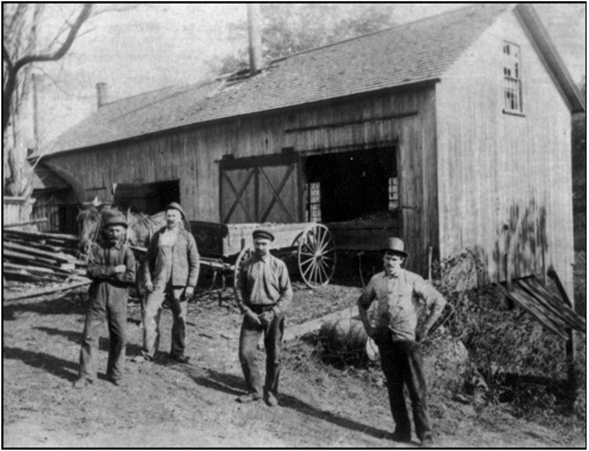
Orchard Hill Road ca.1800s
For thousands of years prior to the widespread use of the steam engine and its application to railroad transportation, water power was the primary motive force for industry. Being a hilly, well-watered region, Litchfield County, in general, and Harwinton were ideal places for industry to develop. From its founding in 1737 to the mid-nineteenth century, Harwinton was home to a considerable variety of small-scale manufacturing businesses.
In History of Harwinton, Raymond Bentley located twenty-six water-powered mills that had operated at various times in the past. In a northern climate such as ours, the growing season was limited, and farmers had the time, and often the necessity, of finding productive winter occupations. The products of grist mills, saw mills and shingle mills were directly related to farmers’ domestic needs and probably always accounted for the largest number of manufacturers. Typical of these operations was the shingle and saw mill operated by the Catlin family on Locust Road. Shingle Mill Brook is named for the mill.
Other mills using local resources were turning mills, operating lathes and other machines, producing wooden products such as furniture, handles, wagon parts, carts, wheelbarrows and ox yokes. A. Johnson’s turning mill was located on Puddin’ Brook.
A fulling mill, where woolen cloth was shrunk and thickened by moistening, heating and pressing, was established by William Huntington in Poverty Hollow below the confluence of the East Branch of Lead Mine Brook and the brook itself. William was the father of Collis Huntington, the railroad tycoon who donated the stone chapel that once stood behind the Congregational Church on North Road. Harwinton sheep undoubtedly provided much raw material for that mill.
Tanneries operated by Deacon Sperry, John Bull, Reuben Barber, David Tyler and Elijah Gaylord, beginning as early as 1788, produced leather that was sometimes further manufactured into items such as shoes, harnesses and saddles. Shoes produced locally were often very stiff and had to be oiled and broken in to be comfortable. Interestingly, shoes could be rented in the winter and then returned during the warmer months when people often went barefoot.
Prominent among the several brick kilns was the one operated at the Birge farm on Spring Hill Road. In 1845, 160,000 bricks were produced at that site.
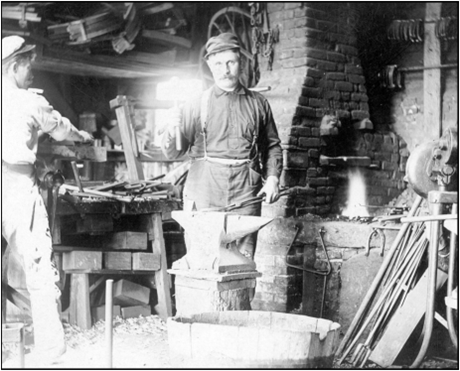
In addition to producers using local raw materials, there were tin shops, a fork factory, coopers, a cutlery factory, a hat shop and clock factories. A hat shop was operated by Abijah Catlin on Burlington Road west of Harmony Hill Road. One of the Hopkins and Alfred clocks, produced in the early 1800’s in Campville was gifted by the Thierry family to the Harwinton Historical Society. Part of the Alfred and Hopkins Clock Shop building and some of their tools (including lathes) are in the Smithsonian Museum in Washington D. C. Percussion cap rifles were also produced by Hopkins and Alfred. Clock parts were produced at several sites in Harwinton. In 1831, clock faces were produced by Isaac Hinman for David Catlin for $2.75 each and in 1848 Curtis Sperry produced 19,724 stenciled clock faces at a Wildcat Hill and Hayden Road site.
Adapting to Change
The most recent venture recorded by Bentley was a coop creamery located “at the foot of the hill” below the center of town. The creamery operated between 1889 and 1901, apparently was often in financial difficulty. With the advent of efficient steam engines to power large-scale factories and railroads to transport raw materials, fuel and finished products, relatively small-scale producers could no longer compete. Even though we can be impressed by the scale of production often achieved by Harwinton entrepreneurs, the concentration of resources and immigrant manpower in the larger cities ensured that Harwinton would return to its more bucolic roots by the end of the nineteenth century. The fact that the rural character of Litchfield County is a highly prized environment for many of us provides some consolation, perhaps. The larger lesson, I think, is that change is the economic reality in all ages. In this age of globalization, the great challenge is to adjust and adapt to that change.
PDF Source:
Tyler, Daniel P. Statistics of the Condition and Products of Certain Branches of Industry in Connecticut. Hartford: John L. Boswell, State Printer. 1846.
For more information on Harwinton industries, see Raymond Bentley’s History of Harwinton. There is a map of the mill sites and other points of interest produced by Bentley and Peter Thierry in the HHS Collection. Copies of the map are for sale by HHS.