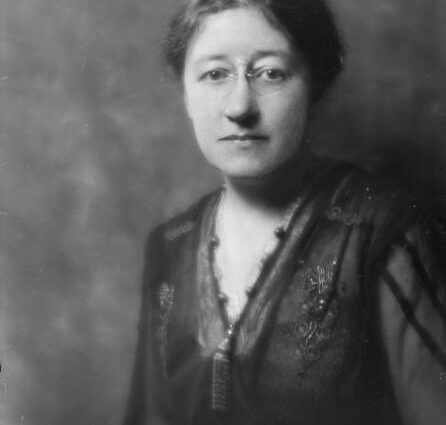
One of the more well-known women of the time to reside in Harwinton was Miss Gerturde B. Lane (1874-1941). Though that name may not ring a bell immediately, she was the editor-in-chief of a popular magazine in the early half of the twentieth century, The Woman’s Home Companion. Under her editorship the circulation of the magazine increased from approximately 727,000 to 3,500,000, and it became the leading U.S. women’s magazine by the time of her passing. She had also been elected as vice-president of The Crowell-Collier Publishing Company, the first woman to hold such a position with a publishing company. By the time she passed away her salary was reported to be $52,000 a year!
Gertrude Battles Lane was born on December 21, 1874 to Eustace and Ella Battles Lane in Saco, Maine. She was educated at Thornton Academy in Saco graduating in 1892, and as a young lady moved to Boston where she started her career as a stenographer. She also found work assisting with editing at a small magazine, The Boston Beacon. In 1903 Arthur T. Vance, editor-in-chief at The Woman’s Home Companion offered her a job in New York as a household editor. She took a $2.00 a week pay cut to take on the job. She described her work there as “a regular maid of all work”. However, it all paid off as she was promoted in 1909 to managing editor and then by 1912 became editor-in-chief. At the magazine she headed a staff which she personally selected and had a multitude of sub- editors. Contributors to the magazine included Eleanor Roosevelt, Willa Cather, Pearl Buck, and Sinclair Lewis. She spent nearly four decades at the magazine.
Her mission at the magazine was to meet the needs of mothers and homemakers. American women became aware of medical advances which led to lowered death rates for women and babies. It had been reasoned that the men at the time were stressing the need to breed animals and crops which met certain parameters for health and production. Thus, her undertaking at the magazine was to promote improved methods of child health resulting in the “healthiest, brightest, and happiest babies possible”, in other words a “better crop of babies”. She wanted not only to protect a baby’s right to be here but his right to “proper treatment for his little body and brain”. Better Babies contests were held across the country.
During World War I she was involved in the Herbert Hoover food administration, dividing her time between New York and Washington. She remained a close friend of the Hoover family and was one of the first to sign a pledge to win over women voters for Hoover during his run for President. She attended his inauguration in March of 1929. During his administration she served on his White House conference on child health and protection. Also, she was a member of Hoover’s conference on home ownership and home building. Former President Hoover later came to Harwinton to visit her according to an October 16, 1939, article in the Torrington Register. Several friends were also with him.
Her time in Harwinton began in 1926 when she purchased a 40-acre property with three buildings which had been part of the estate of William McConway. According to the Torrington Register she purchased the property from a Mr. Irving B. Holley of Torrington who had acquired the property from William McConway before his death. The property included the Anson Hungerford House (on the corner of South Road and Route 4), the Central Academy (which was near the Hungerford house and the Town green), and the next house down from that on South Road. Apparently, the property had been deserted for the prior three years and had been uncared for. Her plan according to the September 28, 1926 Torrington Register was to have a summer home there and eventually make this her permanent home. According to the Torrington Register the lower part of the McConway estate had been purchased by Mrs. Caroline Ball, a well-known sculptress. At the time certain people of importance were purchasing country properties which could be restored to places of beauty, rather than buying brand new homes full of modern conveniences and perhaps without a natural charm or elegance.
Gertrude hired the landscaper who had worked for the previous owner. The grounds of her estate were returned to their previous well-kept appearance and beauty. Her home began to become filled with her fine taste in antique furniture.