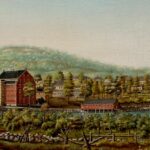
For nearly one-hundred years, from the late 18th century to the latter 19th century, Harwinton was notable among towns of its size for providing the opportunity of a secondary education to area youth. According to newspaper accounts preserved in the Von Tobel scrapbooks, Harwinton hosted two academies and a boarding school at various times in that period.

In researching his History of Harwinton, Raymond Bentley discovered records of the East Academy located at the northeast corner of Burlington and Harmony Hill Roads. Although specific acts of incorporation have not been found, there is considerable evidence of a well-organized association that founded the school in the late seventeen hundreds and operated it successfully into the 1840’s. Many of the early records were signed by Abijah or David Catlin. In 1818, D. McGregor was listed as the instructor of 69 students, 28 of whom were girls. The family names of Bartholomew, Catlin and Hungerford were prominent among the scholars. Harwinton at the time had a population of 1500 people.
Records from 1818 for school supplies provide an interesting contrast to today’s expenses. Abijah Catlin ordered spelling books at two dollars per dozen, geographies at $10 per dozen, grammars at $7.50 per dozen and globes at $18 each. Instructor Elijah Coe was paid forty dollars per month for a school term of four months in 1821. Later in the 1820’s a “rival” Central Academy was being mentioned in correspondence and David Catlin was offering twenty dollars per month salary to a prospective instructor and hoping he would accept eighteen. Apparently two academies were more than the town could support, and by 1841 East academy had ceased to function, the building was sold, moved to a location not far away on Harmony Hill Road and remodeled into a home.

In 1820, Anson Hungerford deeded land west of his house at the corner of Litchfield and South Roads as a site for what became known as Central academy. The school flourished and by 1852, the catalogue of the exercises at the end of the February term listed twenty-eight boys and seventeen girls. The Barber, Catlin and Baldwin names were prominent among the scholars. Theodore Hungerford, who would bequeath Harwinton its first public library building, was a student that year. Instructor Moses E. Wright, a graduate of Wesleyan University, taught students from Litchfield, Hartland, New Hartford and West Granby as well as Harwinton.
The catalogue included a description of Harwinton designed to promote enrollment. Harwinton was an ideal location for an academy because of its “almost total exemption from those influences to which the youth of our larger and more crowded villages are exposed.” In addition, “[t]he inhabitants are eminent for their industry and intelligence, and their character as a steady and virtuous community.” Tuition for thirteen weeks was four dollars and “boarding places” were “conveniently available.” In 1852, there were 45 students in a town of 1200 down from 69 at the East Academy in 1818. By 1865, when the town’s population had dropped to 1000, 26 students participated in the academy exhibition, consisting of 22 recitations, dialogues and essays as well as six musical numbers.