School Supervisor, Photographer, and Author (1874 – 1965)
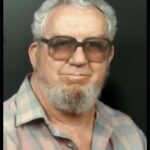
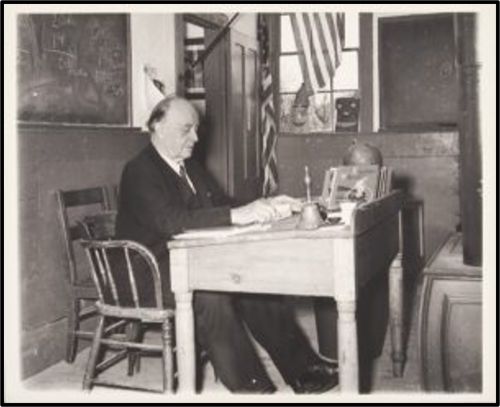
Lewis Sprague Mills was a highly regarded school supervisor, photographer, and author. He served as Rural Supervisor of Schools in Burlington from 1916-1928 and in Harwinton from 1927-1939.
Mr. Mills was born on September 5, 1874, to Archibald and Mary Loomis Mills in Canton Center. His father was a hard-working farmer who raised apples, hay and tobacco. At age 3 “Little Lewis” incurred an injury to his leg which made it necessary for him to wear a brace for the rest of his days. He began his education at age 5, and at 7 he was needed to help his father on the farm. At age 14, his father, needing more help, forbid that he continue with school. Missing school to help at home was common practice at that time. At the age of 18 his mother passed away, but she had pleaded with her husband that Lewis should continue his education. And thus, he was able to enroll in Collinsville High School. After his high school graduation, he continued on at Willimantic Normal School and became a teacher. His first teaching job was in Woodstock, Connecticut. He progressed to becoming principal of the Plainville Grammar School for several years. In 1908 Lewis married May Edith Wilder of Canton. They later became parents of three children. As if he had not achieved a higher educational status than many of his generation, he then went on in 1908 to Columbia University to complete his bachelor’s degree and then a master’s degree in administration in 1912.
Back in 1901 Lewis had saved up enough money to purchase a camera, thus began an additional career as a photographer. In 1902 Lewis Sprague Mills published his first photo. He was asked by news reporters to sneak into a railroad car in Willimantic to take a photograph of quarantined smallpox victims. For this prized photograph, Mills was paid one-hundred dollars. With the money, Mills bought a more expensive camera, and went around Connecticut on a horse and buggy taking photographs. His father constructed a photography studio in their home and Lewis began developing his photographs taken around Canton and over Connecticut. This became a life-long passion. Mr. Mills is especially known for his photos of one-room rural schools. His collection of one-room schools can be found at the Connecticut State Library and includes over 500 pictures. There were in his files over 16,000 negatives. Other subjects include churches, rural scenes and Native American tribes. He particularly worked with the Mohegan tribe in his efforts to understand the history and culture of the tribe. Chief Harold Tantaquidgeon of the Mohegan tribe had high praises for Lewis Mills upon a visit by this writer to the Museum in Montville, Connecticut.
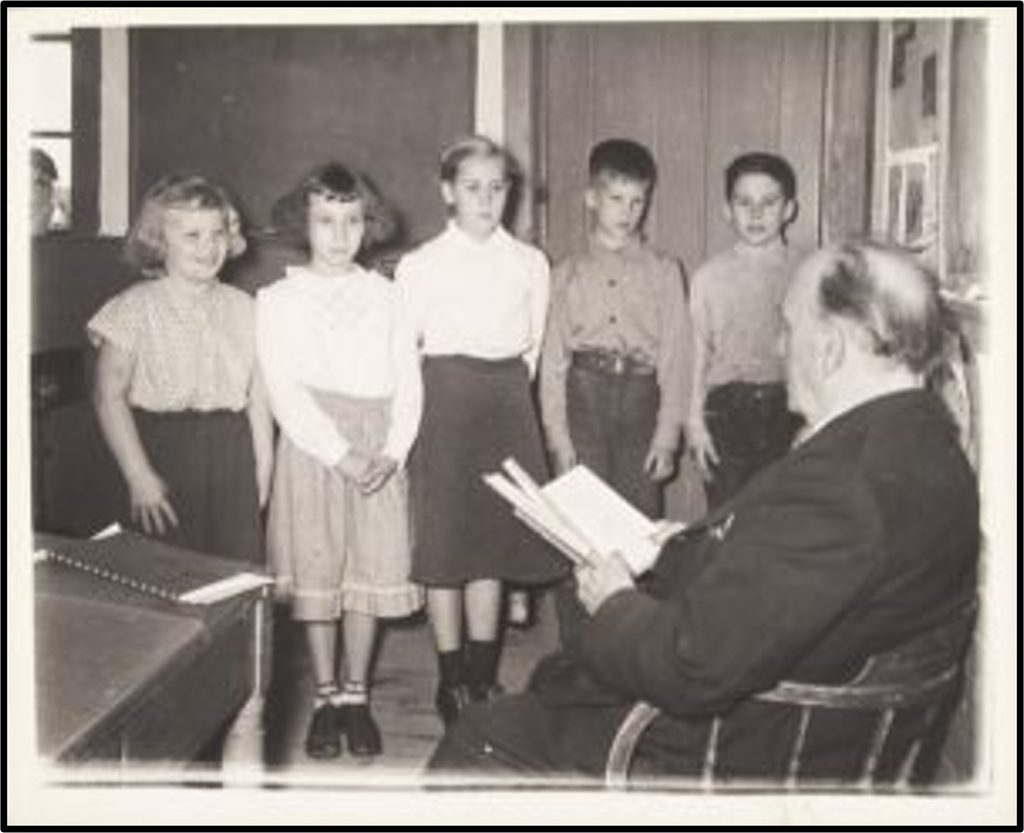
During his time as Harwinton Supervisor of its twelve school districts, Mills also served the towns of Barkhamsted, Colebrook, Hartland, and New Hartford. He valued teaching “from the viewpoint of the student”. He believed in encouraging student questions and discussions, the recitation of poetry, the drawing of maps, and putting on plays. He introduced art and music into the curriculum. He asked the townspeople to provide free textbooks. He urged that students stay in school at least until 7th grade or age 16 in light of his own situation of having to leave school at age 14.
Mr. Mills made regular visits to the schools in his district and knew many of the students by name. One teacher commented that if he arrived, for instance at 10:30 a.m., he knew exactly what subject she should be teaching and on what pages they should be working. He might even ask the students in front of the teacher, “You like your teacher, well, do you?” She did note that perhaps this tightly scheduled approach did stifle creativity. She must have been a great teacher, however, as she continued her teaching career for many years! He believed in discipline but fairness.
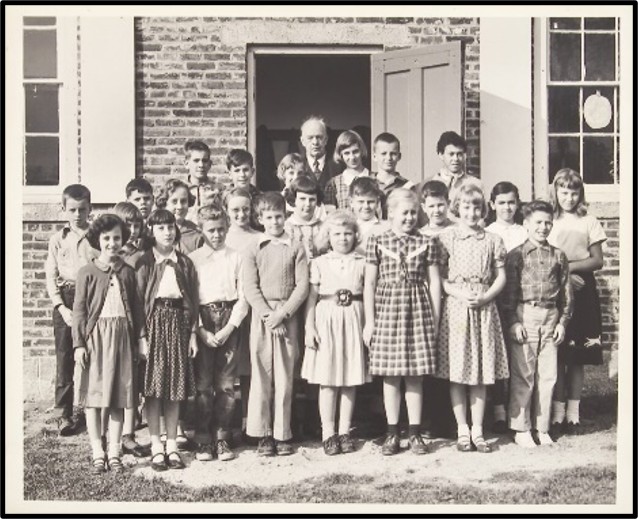
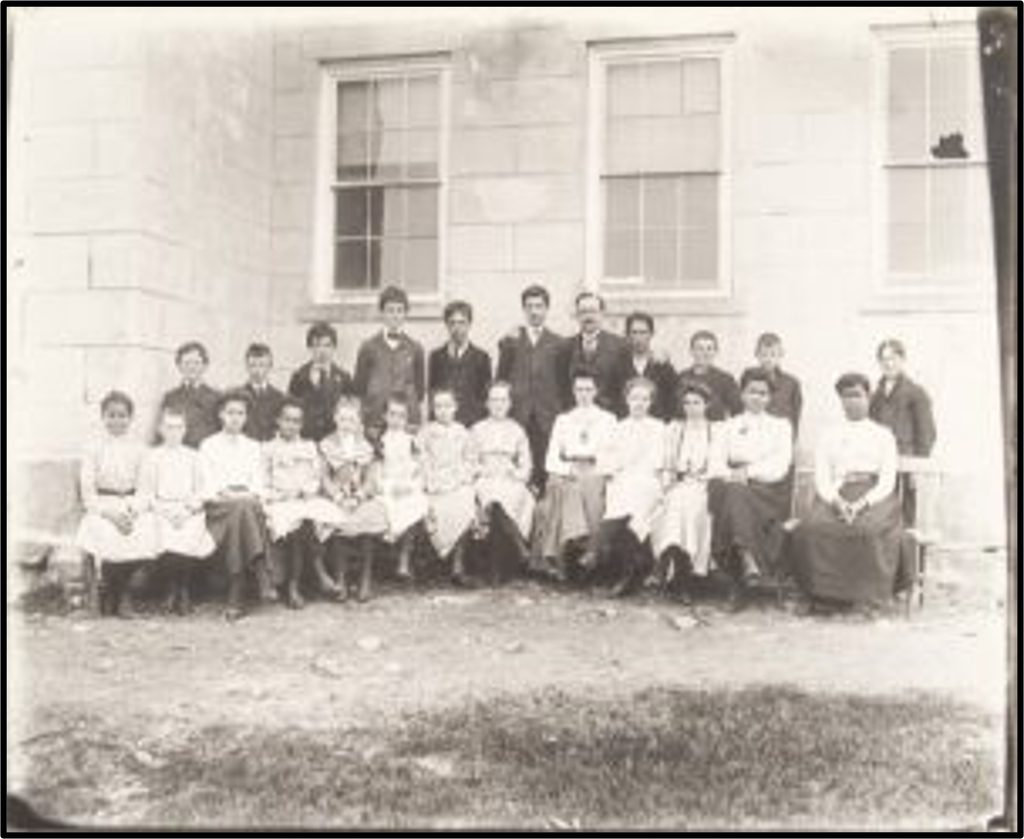
Lewis S. Mills stands at the rear
There are many newspaper reports of his attending special gatherings such as speaking contests, awards for perfect attendance, and other occasions in which special prizes were awarded. He would take photos on the last day of school. Mr. Mills had responsibility for the curriculum. He had a strong interest in rural historical sites both locally and throughout Connecticut. In an account from the Register Citizen in August 1934, the schools in each town for the coming year were to study their local histories. This was in conjunction with the tercentenary in 1935. They were to document a list of houses in their specific districts and the dates they were built. All houses were to be listed. Students were also to learn about the trees, the rocks, and the animals within their respective areas.
There were after hours teachers’ meetings to discuss curriculum and other matters. One account notes that he organized a chicken dinner for a meeting with the Boards of Education and Selectmen in the towns in his supervision districts. At the state level he was appointed to serve as State Education Chairman of the George Washington Bicentennial 1933-1935.
In 1918 Mills had been appointed by the State Board of Education to lead a committee to write a school booklet on the history of Connecticut. Mills took on the project himself as something he wished to accomplish. He spent twelve years on the project and produced The Story of Connecticut, a 6th grade textbook of 400 pages. It was first published in 1932 with the final edition in 1958. The book covered the State’s history including people, geography, constitution, government, and innovations. The book is no longer in use as a textbook as the goals for today’s social studies curriculum have changed.
Of separate interest was a short notice in the Saturday, September 29, 1934 Torrington Register that schools were closed on Tuesday afternoon in observance of the death of Mrs. Lewis Mills, wife of the Supervisor of Schools, whose funeral was held at Canton Center that afternoon.
Following his retirement as School Supervisor, Mr. Mills at the age of 65 continued his career as an author. He became the editor of a publication, The Lure of the Litchfield Hills, a magazine which highlighted articles of historical interest in the area. Another publication of Mills was The Legend of the Barkhamsted Lighthouse, also a tale of local historical interest.
Lewis S. Mills ultimate honor came in the naming of the new high school for Regional District 10, Lewis S. Mills Regional High School. The high school serves the towns of Harwinton and Burlington, and is located in Burlington. Lewis Sprague Mills attended the ceremony on November 23, 1960 in a wheelchair, expressing delight and wishing to share this honor with all of those who had worked with him throughout the years.
Lewis S. Mills passed away 4 ½ years later on March 7, 1965 at the age of 90.
References:
Photos: Connecticut State Library
Lewis S. Mills High School Website
Wikipedia
State Archives Record Group No. 064
Connecticuthistory.org/lewis- sprague-mills-and-the-story-of-connecticut
Torrington Register Archives
Campville Chronicles